Technology offers an increasing—even bewildering—number of tools to use in different stages of the writing and editing process. Some offer great benefits, and many have drawbacks. For my part, I haven’t adopted any “AI” tools for writing or editing. I never input any of a client manuscript into an AI interface to be analyzed, and I don’t use AI to generate written feedback (nor for writing blog posts, fiction, or poems). When doing research, I scroll past the AI-generated search summaries (which warn you themselves that they aren’t always accurate) and look for actual sources of information.
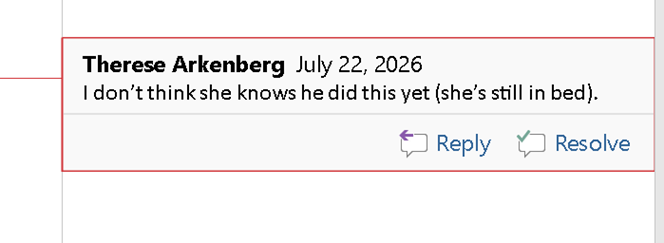
My tracked changes and comments are timestamped as I write them over multiple reading and editing passes.
As for why I’m avoiding these tools:
First, my clients have legal and ethical reasons for wanting me to eschew AI
This summer, prestigious publishing and movie deals have fallen through because of concerns that AI was involved in writing a story. One reason both publishers and film producers are wary is because AI-generated work isn’t protected by copyright. For any author seeking traditional publication or who hopes to make spin-off deals for their intellectual property in the future, the safest course is to avoid AI to keep their copyright clear.
In addition, suspected AI use can damage a writer’s reputation, not least among other authors. Anthropic has been held liable in court for copyright infringement because of how it used published books as data training for its model. (Several of my clients were impacted.) Some hold the perspective that writers who use AI tools are participating in a large-scale act of plagiarism.
On top of all this, many writers and readers have environmental and political concerns about AI and the companies that provide it. I share these concerns, but even if I didn’t, the copyright issue alone would be enough for me to avoid using AI for the sake of my clients.
(As I wrote this blog post, I received an email about a call for submissions that included the guideline, “Stories that used AI for planning, editing, modifying or generating text will not be accepted. Please confirm in your submission email that you have not used AI in these ways. The contracts for accepted authors all require a signature declaring that AI has not been used.” This is just the most readily available example of publishers, literary agents, and literary contests who refuse to consider work that has used AI in any capacity.)
AI use is difficult to prove and also difficult to disprove (in fact, there’s an entire philosophical debate on whether it’s possible to prove a negative). AI detectors are not fully reliable; at the same time, LLM-generated text often has stylistic and structural tics that editors, writers, and readers are becoming familiar with. Human authorship also has evidence, such as records of writing and revision. I recommend my clients keep all previous drafts of their stories—this has always been a good idea, in case you change your mind about a revision or want to revisit your old work for nostalgia’s sake, but it also offers some record of how you did the writing and rewriting.
What I can guarantee to my clients is that AI use will not enter their story’s process from my side.
And the words in every story are chosen by my clients—my feedback is for them to consider and incorporate as they decide. They take pride in their work, and their readers are fans of their unique voices.
Second, even when kept to the outlining or editing stages, AI can alter the voice and the substance of writing
This can happen in subtle ways the writer might not be initially aware of.
This essay by Rob Secundus summarizes [brackets are my additions for clarity, bolding is mine for emphasis]:
Research by Google “found that “extensive use” [of AI/large language models] also shifted the meaning of the words on the page, not just the voice. Specifically, they found that LLMs shifted arguments toward neutrality…[and] it’s hard to argue that LLM usage wouldn’t inherently result in some kind of convergence among users that approached the same question. The more variance it gives in its answers, the more likely it is to hallucinate [giving incorrect information]. One might argue that this convergence is a good thing, that this means people using the LLM would be less likely to arrive at false conclusions—but it also means that the nuances of each individual’s conclusions will likely be sanded down. It results in a loss of perspective just as well as of voice… When asked to revise previously published work, and even specifically to “only make grammar edits,” the resulting products were still homogenized, LLMs “still change[d] the text in a way that significantly alters its semantic meaning.”
Here’s a link to Google’s study: https://arxiv.org/abs/2603.18161
And another study has found LLM use lessens linguistic diversity and homogenizes style, not only for individual writers but across the world as a whole, from social media posts to scientific papers to creative writing.
Using AI to edit reduces the author’s voice and its unique contribution to writing as a whole.
Third, books are written to be read by humans, not by robots
At least I haven’t yet met a robot with a Kindle Unlimited subscription, a library card, or a bookshelf. ;D
Vanessa Lawrence, in an article for Writer’s Digest, puts the relationship between writer and reader strikingly: “As a writer, you’re asking complete strangers to spend hours of their time in the world of your stories.” Authors invite readers to immerse themselves in their words, and usually to pay money for the privilege.
The only way to know how a human will experience those words is to have a human’s feedback.
Writers (I include myself here) have reassurance when an attentive editor shares feedback about what confused them or emotionally moved them. Editing isn’t just a mechanical matter of catching typos, but a thoughtful one of spotting opportunities to make a story more vivid, mending plot holes, and ensuring the words flow smoothly.
As I’ve said, there are many different technological tools available to help with the writing process. My clients have incorporated more than I can name, and it’s great to get as much revision and feedback as you can. When my clients work through several drafts before hiring me, it usually leads to a cleaner manuscript so we can focus our brainpower on solving the handful of remaining concerns. But no matter how many spreadsheets, worksheets, drafts, or how much feedback from Grammarly or ProWritingAid (both of which have now started to incorporate AI) a writer involves, the human reader will turn up new opportunities for improvement.
A good human editor is able to recognize the nuance and techniques of a story—things like unreliable narration, plot twists, the use of subtext, and a sense of humor—and to recognize flexibility in style. Sometimes an author doesn’t want to use perfect grammar because that doesn’t fit the voice of their story or characters. In fact—lean in so I can whisper this secret, please?—“correct” grammar, spelling, or punctuation isn’t always cut and dry. It can depend on context, location (in the US, “toward” has no -s, in the UK, “towards” does), and personal preference.
AI-generated text—which is what AI editing feedback consists of—also shows a poor understanding of objects in physical space and how the human body works, as one might expect from software with no consciousness or worldview. Then there are the outright errors. In the previous section I quoted an essay that refers to “hallucinations,” the incorrect information that appears in AI-generated text. Nobody wants hallucinations in their stories—or in their editorial feedback. Yet some authors have received them in developmental edits they’ve hired through Reedsy, a platform that offers the services of editors with years of experience at large traditional publishers (similar concerns have arisen on other platforms, including Fiverr, one I use myself). Here’s one writer’s account, with excerpts from the feedback (and here’s another Reddit thread in which a representative of Reedsy offers ways for authors to address concerns).
In addition to hallucinations, the feedback is often generic or misapplied. It’s true some cliches of writing feedback have become cliches because they’re so often good ideas—I’m putting together my thoughts for an essay on “show, don’t tell” to publish someday, and “begin your story later than you think you should and end it earlier” is a tip I’d encourage every writer to try (then to reject if it doesn’t work out in a particular instance). Yet over-broad feedback will miss the specific needs of the story, sand down its distinctive strengths, or try to force the story into a mold it isn’t even trying to fit.
Though talking with clients, other editors, and other writers and readers, I’ve come to understand one of the benefits I bring my clients is that I’m a super-reader, enjoying over 200 books each year in a wide variety of genres, from authors all around the world, written in the 2020s and the 1820s and anytime in between (and occasionally earlier—my current audiobook is Shakespeare’s Richard III.) I’m familiar with diverse genre conventions and storytelling traditions, while also knowing enough to realize I don’t know everything, and a writer doing something differently from what I see most often doesn’t mean they’re “wrong.” I understand the patterns common in successful stories in different genres, but my job as an editor is to help the writer tell their story, not perfectly match a preset pattern. (And sometimes I can help a writer realize they’re writing in a different genre than they thought: not all love stories are genre romances, and there are many subgenres of romance, fantasy, horror, crime fiction…)
What my feedback looks like
If you’re curious about what my feedback would look like on your specific story, consider a free sample edit. I offer them on up to 2,000 words of any book-length story (about 40,000+ words). You can receive one by sharing an excerpt in this form, which also has a few optional questions about your interests, goals, and concerns as a writer.
Finally, I don’t use AI because I don’t need to or want to
On top of the legal, ethical, and practical concerns, I simply haven’t felt the need to incorporate AI into my workflow. I’ll acknowledge that it may have incorporated itself in some places, because most software now includes AI-generated code; I also acknowledge that machine learning can have significant benefits—the ability to match patterns at scale can improve cancer detection, and in the world of mathematics, AI has apparently been able to solve longstanding problems. But a story is not a math problem.
Since I earned my copyediting license over ten years ago, I’ve continuously educated myself about writing and editing, including ways to make these processes more efficient. (The SFWA Writing by Other Means series offers a wealth of creative techniques, and in particular I want to evangelize Rachel Aaron’s Triangle Theory for more sustained productivity with words! You can find more of my favorite reading on writing and editing in this post.) But I’m not interested in shortcuts that lead to messier work or remove the fun from the process. As I tell people when I introduce myself, with a gleeful grin, “I get to read for a living!” Why would I want to skip the reading? Or the opportunity to help a reader hone her voice, develop her story, and meet her goals?
Writers, readers, and editors have to make decisions every day as we navigate the challenging publishing landscape. We won’t all make the same decisions. (For what it’s worth, I suspect some people will find my attitude toward AI too harsh, while others will find it too permissive.) This is my personal policy. Please let me know if you have any questions!