Over the years, I’ve shared many resources with my friends and editing clients, as well as learning from them myself. Here’s an ever-growing list of the books and articles I’ve found most helpful.
I deliberately list them in no particular order. Some are more about writing a first draft; some more about editing or marketing. Some are newer and some are classics. Some are about particular genres, but you’ll often discover interesting new ideas by reading about a genre outside the one you primarily write in! Romance will teach you about characters and relationships; mystery will teach you about exposition and suspense; science fiction will teach you about how to observe the world of your story. This list includes books on poetry because their lessons can be useful anywhere you want to select words and organize sentences for particular effect—which is everywhere.
This page uses affiliate links, so if you make a purchase, I may earn a small commission. But I also encourage you to stretch your book-buying budget and support your local library by checking out titles they have in circulation. If you add the Library Extension in your browser, when you visit a web retailer or Goodreads page for a book, you can see at a glance if it’s in your library system.
Self Editing for Fiction Writers by Renni Browne and Dave King (Bookshop.org)
Whether dissecting dialogue tags or judging the balance of scene vs summary, Browne and King get into the word-by-word impact of writing and editing without being highly technical or overwhelming. Despite the title, it’s worth reading for nonfiction writers as well, especially writers of memoir or other narrative nonfiction. As an editor, I encourage all writers to develop their self-editing skills alongside using my services. It’s the best way to strengthen your own voice.
It Was the Best of Sentences, It Was the Worst of Sentences by June Casagrande (Bookshop.org)
Books on grammar, including some of Casagrande’s other books, risk getting dry, dense, and overwhelming. This one, however, offers practical examples of how good grammar makes writing more readable. Its brief, clear explanations include touches of wry humor. (Lynne Truss’s Eats, Shoots and Leaves is another book that makes the case for subtle points of punctuation in a thoughtful manner that’s surprisingly low-stress.)
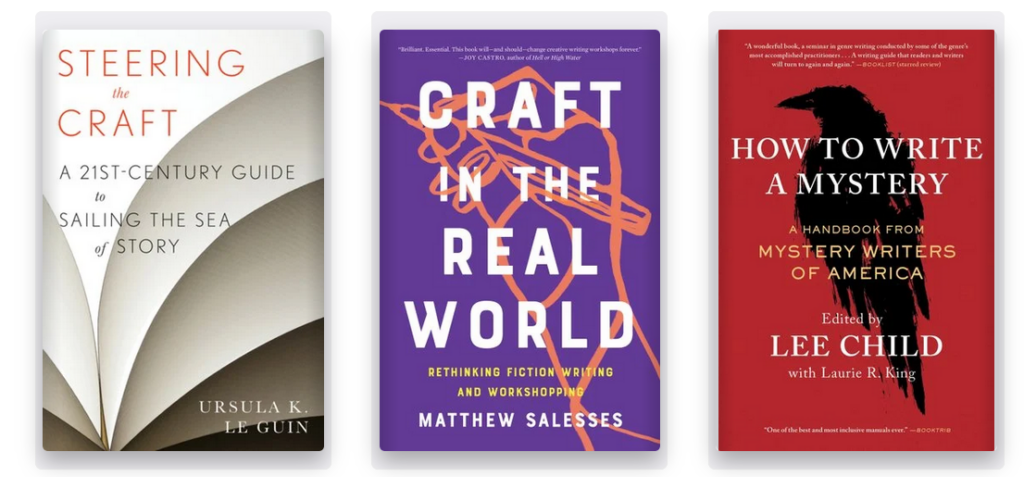
Steering the Craft by Ursula K. Le Guin (Bookshop.org)
A guide to different fiction techniques by a master fantasy writer, with a number of exercises to practice with.
Ron Carlson Writes A Story by Ron Carlson (Bookshop.org)
A short book about the making of one short story, this is one of the most resonant descriptions of what it’s like to be in the trenches of writing that I’ve ever come across.
Craft in the Real World by Matthew Salesses (Bookshop.org)
Writing is rarely a question of objective right and wrong, but rather a matter of choices that better connect with different audiences. Writers don’t all come from the same background, and we don’t all write for the same community of readers. In particular, writers from marginalized backgrounds are often pressured to write for a presumed majority audience and judged by misapplied standards that overlook their craft decisions. Salesses offers guidance for giving and receiving feedback more thoughtfully. While its primary audience is members of writing workshops, you’ll find it useful even if you don’t participate in workshops.
Finish: Give Yourself the Gift of Done by Jon Acuff (Bookshop.org)
Acuff takes a counterintuitive but welcome to motivating yourself over the finish line: reduce the pressure on yourself and make things easier. Whether your goal is your first draft or a marketing campaign for the publication of your latest book—or another task that’s been hanging over your head, unrelated to writing at all—it can feel a lot more achievable with Acuff’s advice.
On Writing by Stephen King (Bookshop.org)
King describes many baseline expectations that audiences—from paperback readers to acquisitions editors—have developed about stories and writing style, as well as sharing his own rules of thumb and personal experiences, combining advice and memoir. It’s a useful introduction to the craft for writers in any genre, not to mention entertaining and often thought-provoking.
Consider This: Moments in My Writing Life After Which Everything Was Different by Chuck Palahniuk (Bookshop.org)
Another combination of memoir and hands-on writing advice, this is one not to read while eating…but I do suggest reading it.
The Artist’s Way by Julia Cameron (Bookshop.org)
A very encouraging, meditative look at the creative process—this may be one to go to if you’re feeling overwhelmed by how to apply all the advice you’ve learned in the other books, or when you’re blocked or stuck. (Natalie Goldberg’s Writing Down to the Bones is another useful and thoughtful book for thoese who approach writing as an almost spiritual practice.)
On Becoming a Novelist by John Gardner (Bookshop.org)
This classic of writing advice may be most useful for what it says about reading: Gardner’s “fictional dream” is a state of immersion so deep that the world of the story becomes real and the page turns transparent. The craft of writing, then, is to avoid reminding readers of the words on the page (though this is not every writer’s goal). Gardner himself describes the aim of this book as “to deal with, and if possible get rid of, the beginning novelist’s worries.”
Writing Tools, Help! for Writers, Tell It Like It Is, and other books by Roy Peter Clark (Bookshop.org)
Clark is a prolific writer of advice, often targeted at nonfiction writers but useful for every writer wishing to be more clear, precise, and effective.
Nail Your Novel: Why Writers Abandon Books and How You Can Draft, Fix, and Finish With Confidence by Roz Morris (Bookshop.org)
Whatever the challenge you’re facing, Morris offers a specific, actionable suggestion in nearly every sentence. It’s full of advice for the plotting, research, drafting, and self-editing stages. As with all books of writing advice, not every piece will resonate with every author, but even the tips that didn’t quite work for me gave me new ideas and tools. (My one caveat is that language describing characters in two examples in later chapters is unfortunately dated and insensitive. This doesn’t impact the practical advice, but may be jarring.)
Worlds of Wonder by David Gerrold (Bookshop.org)
With chapters on everything from E Prime (writing without the verb “to be”) to the benefits of interviewing your characters (which permanently changed my thinking for the…more interesting), Gerrold’s advice will empower writers in all genres, though this book is especially useful to science fiction and fantasy writers.
How to Write a Mystery: A Handbook from Mystery Writers of America (Bookshop.org)
Seventy mystery, thriller, and crime writers share what they’ve learned about research, characterization, pacing, plot twists, publishing, and more.
Mastering Plot Twists and other books by Jane Cleland (Bookshop.org)
Cleland is a mystery writer who writes excellent practical guides to applying suspense, surprise, and tension in any genre. (My one nitpick is I think she sometimes massages the definition of “Twist, Reversal, and Heightened Danger” in her examples to make her case, and these terms are never as clearly defined as I would like. But they work on a “know it when I see it” basis and the flexibility may even be a virtue.)
I haven’t gotten my hands on it yet, but I also want to pass the word on about Cleland’s new book, Beat the Bots: A Writer’s Guide to Surviving and Thriving in the Age of AI.
Write Naked by Jennifer Probst (Bookshop.org)
A bestselling author’s guide to writing and selling romance, this book also has a great chapter gathering advice from other romance authors for a wealth of perspectives.
Show Your Work by Austin Kleon (Bookshop.org)
An accessible guide to self-promotion and sharing so that artists and creators become findable through their generosity. Highly recommended for writers who feel intimidated and uncertain about marketing their stories.
A Poetry Handbook by Mary Oliver (Bookshop.org)
Quite a few prose writers are also poets, and if you’ve ever wanted to learn more about poetry, Oliver’s short book about poetic techniques and revision offers a warm welcome to the form.
In the Palm of Your Hand by Steve Kowit (Bookshop.org)
Techniques like imagery, metaphor, and the selection of precise detail and word choice are used by prose writers as well as poets. This “portable workshop” includes lots of writing and revision exercises along with guidance and inspiration. Its chapter on “Awful Poems” teaches a lot about imperfect prose, too.
Meander, Spiral, Explode by Jane Alison (Bookshop.org)
An exploration of different forms a story might take beyond conventional plot formulas and how pattern can create momentum that keeps the reader turning pages.
Essays One by Lydia Davis (Bookshop.org)
This collection of essays covers a wealth of topics, including art, translation, and literature, as well as advice on writing and behind-the-scenes accounts of how Davis has written some of her own fiction.
In time, I hope to conclude this list with my own book of advice on editing!
Online Articles
- My blog post “12 Words to Almost Always Cut” identifies a dozen common problem words and phrases, weighs when they might be useful, and offers tips on how to catch them ine manuscript and ways to rephrase.
- GrammarBook’s list explains what those commas are doing.
- The Editor’s Blog explains how to punctuate dialogue.
- Allen Guthrie’s “Hunting Down the Pleonasm” is helpful for clarity and concision, honing each line until it contains the most effective words to convey emotion and information.
- In addition to the pleonasms tipsheet, Guthrie has written a list of “Infamous Writing Tips,” which can be read on the Absolute Write Forum (a writing, editing, and publishing resource which I also highly recommend). Perhaps the best rule on the list is 32, “If something works, forget about the rule that says it shouldn’t.” But if something isn’t working in a draft, one of these “rules” will often illuminate why.
- Like pleonasms, “filter words” can steal oxygen from a manuscript; identifying them and rephrasing can deepen point of view and immerse readers more fully in the story, as Suzannah Windsor Freeman’s article on filter words for Write It Sideways explains.
- Kathy Steinemann’s more recent article on filter words elaborates with more examples, exercises, and ideas for avoiding filters while still using all 5 (or 6…or 12!) senses in a manuscript.
- Now Novel offers tips and considerations for point of view, especially in a novel with multiple POVs, although most of these suggestions are also helpful to develop a single POV in a story.
- Ben Yagoda at Writer’s Digest offers 5 tips and warnings about word repetition.
- This post on the Kill Zone blog offers tips for action scenes and great examples of paragraphs “before” and “after” editing them to be clearer and more effective.
- The Turkey City Lexicon was developed among fantasy and science fiction writers swapping feedback in workshops, and even if you don’t write SFF, you’ll benefit from learning about infodumping, handwaving, “said”-bookisms, and the Not Simultaneous problem.
- Editor Beth Hill’s article, “How Goes the Flow in Your Story?” warns against several ways a writer might interrupt the reader’s reading. (I’m reminded of a quote from Virginia Woolf, shared by Margot Livesy in her book The Hidden Machinery: “Style is a very simple matter; it is all rhythm. Once you get that, you can’t use the wrong words.” Until you get that, it’s a matter of learning to spot the wrong words and developing alternatives. Hill incisively diagnoses a number of issues and potential fixes.)