Welcome to the second part of my in-depth look at the editing process! Today, we’re going to look at the kinds of suggestions I make when working directly on manuscripts word by word, sentence by sentence, and paragraph by paragraph (the more holistic feedback given in developmental editing will be the subject of my third and final post in this series. Part One, on my editing approach and tools is here.).
You may find this serves as a useful checklist for your own self-editing. (I encourage every writer to invest time and attention editing their own work—it develops your voice and strengthens your writing. As for my job security, writers hire me because they know there’s no substitute for a fresh, educated, and experienced second perspective.) And this series is especially made for those who like to have a lot of information about what to expect. You can read a shorter description of my process and services on my editing page, and you can find out firsthand what my feedback on your writing will be like by filling out this form for a free sample edit on 1,000 words.
What’s the difference between line editing and copyediting (or copy editing)?
A great question that I’m going to try to answer concisely! First off, I use “line-by-line editing” for this kind of work to distinguish it from developmental edits that provide feedback in written summaries, rather than by offering suggestions directly in the story file. This direct markup is what people most often think of when they think of editing (they may imagine it in the form of red ink scrawled across their pages, an unfortunately intimating image!), so it’s what I’m going to talk about first. However, in practice, it’s usually best to get developmental editing done first, so you know your story is in great shape and every scene in it serves a purpose. Then line editing helps you to strengthen and polish each of those scenes.
Of the two, line editing is more thorough than copyediting. A simple way to think of it is: copyediting corrects errors and inconsistencies. Line editing does that too, but also offers suggestions to make already good writing even better.
As I learned when earning my copyediting license, there are three “levels” of copyediting: light, medium, and heavy. The lighter the copyedit, the more limited the changes it suggests. Additionally, in heavier copyedits, the editor is more likely to offer examples of how to rephrase something, while in lighter copyedits, we more often point out an issue but leave it to the author to revise.
If both line and copyediting are done on the same manuscript, line edits are done first, since they involve more changes. (And proofreading comes after copyediting as the final step to catch remaining typos. I’ll talk a little more about that at the end of this post.)
To get the best editing outcome, talk with your prospective editor about what sort of feedback you want, what you don’t want, how you’d prefer it to be given, and any particular areas of concern. Additionally, look into getting a sample edit! Most of us offer free samples on a few pages of the manuscript. (Here’s my form for potential clients to request a free 1,000-word edit.)
As for whether it’s “copy editing” or “copyediting”: It can be both, depending on the style someone is writing in. (Making sure you’re consistent on style—matters of spelling and punctuation that aren’t correct or incorrect, just done differently in different publications—is one service a copyeditor provides). The Chicago Manual of Style, the style guide I use by default, has it as “copyediting.”
The list that follows describes the suggestions I most often make as part of my standard line edits, which some might also describe as heavy copyediting. However, every manuscript is unique; I don’t make all these recommendations on every story, and some stories get additional feedback in other areas.
A line and copyediting checklist
As mentioned above, copyediting corrects grammatical errors and ensures style consistency. What is style consistency? For example: do you add a possessive ‘s or just an apostrophe to a name already ending with s—James’s or James’? And is it OK or okay? Either form is correct! An editor makes sure you don’t confuse readers by using both.
Common grammar, spelling, and punctuation topics I address:
- Dialogue punctuation
- Dangling modifiers
- Unintentional tense changes
- Confusing or unintentional-seeming sentence fragments and run-on sentences
- Changes to spelling of character names (Sara or Sarah or, in a typo, Sarha)
- Spellings and misspellings of brand names and trademarks (to reduce the need for corrections by an editor, I recommend looking these up these as you write because they can be counterintuitive)
- Pleonasms—unnecessary words or phrases that slow the pace, weaken the voice, or confuse the focus of the story
- Repetition of descriptions, actions, ideas, sounds, words, or sentence structures.
- Repetition is one of the more common style complaints readers raise in book reviews, even when they otherwise enjoy a story, and it can be difficult to spot in your own writing.
- When I see a simple way to rephrase or delete an instance of repetition, I suggest it as a Tracked Change. In other cases, I highlight the repetition for you to address in your own voice.
- However, variety for variety’s sake is unnecessary, and repetition can serve a purpose. As an example—in addition to my use of “variety for variety’s sake” just now—parallel structure uses the same pattern of words to make a section of writing clear to follow and pleasant to read.
Beyond grammar, I also also advise on:
- Organization, pacing, and focus of scenes and chapters, as expressed through words and sentences
- Are readers getting enough information, but not too much, and in the order they need it?
- Does the scene move quickly or slowly? Would it be more impactful if it were quicker, or slower?
- What is the scene about? What is each character’s goal and motive? Are these made clear?
- How does each sentence and paragraph move the scene and story forward?
- Word choice for accuracy, clarity, and appropriate tone
- Different words might fit each character’s voice, the setting, or the mood of a scene. In giving advice here, I consider both the dictionary definitions and connotations of words.
- The dictionary I primarily use is Merriam-Webster.com. I also use Dictionary.cambridge.org to check international spelling and usage, and if a word doesn’t appear in either, I use a search engine to find examples of how it’s most commonly used.
- Sentence structure and organization for clarity and impact
- A sentence that’s technically grammatical might still mislead or frustrate readers. Some call these “garden path sentences” because they lead readers “up the garden path.” I warn where a sentence seems to do this and offer suggestions to make its direction clearer.
- Sometimes, a sentence’s ideas don’t clearly follow from or lead to the surrounding sentences. I may suggest relocating the sentence or adding a clearer transition.
- I can help catch where actions are described out of chronological order: “He ran out the door after hurrying downstairs” almost has the reader picture the protagonist moving backward.
- I help spot where characters perform actions that are physically impossible. For example: “balancing the tray on both hands, she pushed the door open with her fingertips” and “he spoke, sighing.” These both sound okay…until the reader tries to imagine them happening.
- In line editing, I can help you take a good sentence and make it great!
- Sentences, like stories, have climaxes. Prevent anticlimax by ending important sentences with vivid, significant, or surprising words. (“Sentences have climaxes, like stories do” would be a less impactful order, wouldn’t it?)
- Some information could be stronger given as a statement instead of a question. Or it might be more emotionally powerful if phrased as a question rather than a statement. (Can you think of some examples?)
- Sometimes two shorter sentences are more effective than a single long sentence—or vice versa.
- I give shout-outs and compliments to lines that are great as they already are! And alongside my line edits, I also use comments to share brief “reader reactions,” from “It’s heartwarming to see them kiss at last!” to “Oh good, I was hoping he’d get a nasty comeuppance.”
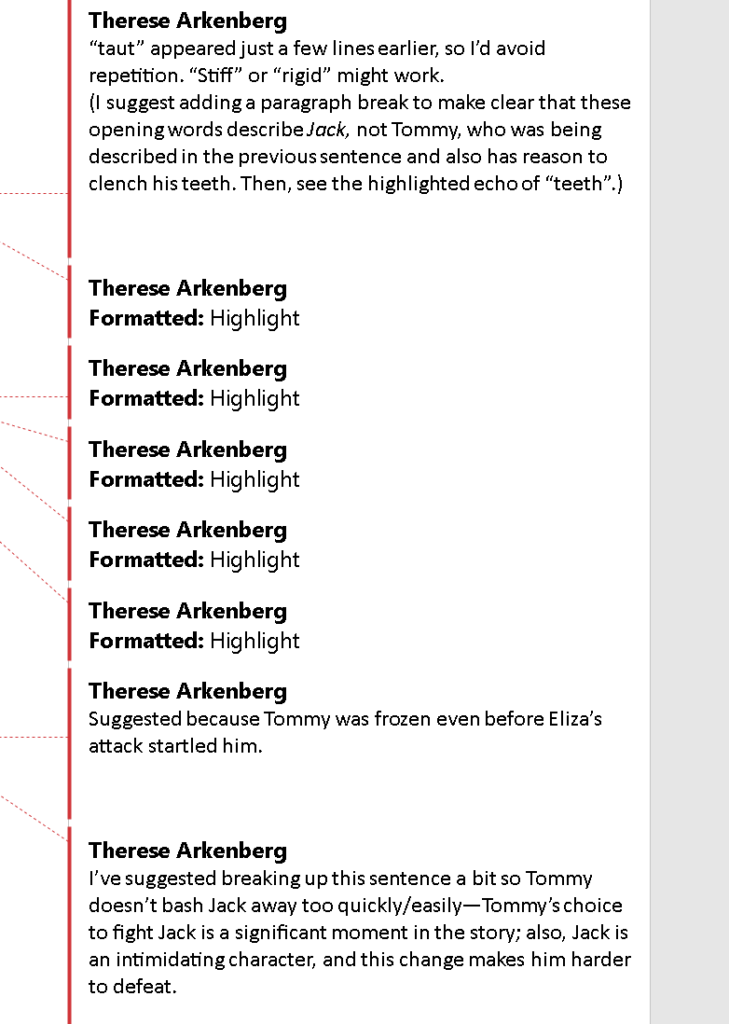
A big value I add in many edits is help with continuity and small-scale fact checks.
- Do the physical descriptions of your characters, their homes, and other details remain the same? (Do they drive a red car in Chapter 3 and a blue car in Chapter 5?)
- Did your character sit in an armchair on page 15 and stand up from an ottoman on page 17? In between, did they walk anywhere? Do they stand up again on page 18? No shame if any of this happens—it’s very common in early drafts—but I can keep it from happening in the published draft.
- When your characters’ feelings, attitudes, and motivations change, is it clear why? (Or is it clearly a mystery that will be solved as the reader reads on?)
- When the point of view (POV), the perspective that the story is told from, changes, is it clear why? In most books, it’s best to signal a POV change by starting a new scene or chapter. At minimum, avoid multiple POVs in a single paragraph (unless you’re committed to a postmodern experiment, in which case please discuss your specific goals with your editor!).
- I am not omniscient and I’m not a professional fact-checker. But I am widely read and curious about many topics. If it comes up, I may tactfully share where I’m unsure about something you’ve said. (Sometimes this is part of making sure word choice is accurate; line and copyeditors always consult a dictionary if a word is used in a way that might seem nonstandard.) When I’m wrong and you’re right, you might provide more context in the story so readers who share my misapprehension learn better.
- An example: there are many supposed quotes from Oscar Wilde, William Shakespeare, and Mark Twain floating around out there. If you quote one of these writers and the quote doesn’t sound like them to me, I’ll look it up and let you know if it turns out to be apocryphal.
- Another example: I enjoy learning about edible wild foods. If you write a character picking wild strawberries in September, I’ll write a comment sharing that I’ve usually seen them in June (maybe late May or early July depending on weather and location).
A few other benefits of line-by-line editing you might not have realized:
- The Curse of Knowledge can affect all writers: it’s hard to put yourself in the shoes of a reader who doesn’t already know what you know. You may think you’re writing clearly but refer to something the reader doesn’t understand. You might write a scene that would have more emotional power if you gave the reader certain background information first. That’s where I come in, as a “professional reader” who can let you know when I find something confusing.
- Both showing and telling have their place in a story. I will not recommend always showing and never telling. But I’ll let you know if you’re telling information you’ve already shown, or if information is interesting and significant enough that it might be better shown than told (or the inverse: some information might be important enough to tell in a summary, but not vital enough to dramatize at length).
- I can help you decide where a piece of information would be most effective.
- I can help you spot if a scene’s emotions feel unearned (without enough setup, passion can tip into melodrama) or where a scene could be made more intense.
- I’ll help you spot cliches and stereotypes. Often our first thought isn’t the freshest, or the truest, or the best thought for our story. Cliches can be a sign of fuzzy thinking (quite a few plot holes can arise if an author relies on a stereotype rather than considering things more deeply) and they risk boring readers—or offending them.
- I’m not a sensitivity reader, but part of an editor’s job is to offer advice on respectful, accurate, and up-to-date word choice. (It’s helpful to remember, here and with every editing correction: You didn’t know before you learned from the correction. Nobody knows everything. But now you do know and can write more consciously and effectively!) If you’re writing a character with a background and experiences very different from your own, sensitivity and authenticity readers are a valuable resource to consider in addition to thorough research.
That looks like a lot when written out—and it’s still just a list of the most common suggestions I make, not every kind of suggestion I offer!
Some story drafts are very solid grammatically, but need help with pacing. Some manuscripts have fine pacing but need help avoiding repetition of particular words or phrases. Usually it takes a few drafts to fully refine a piece of writing. Before hiring me, my clients often share their stories with beta readers for initial impressions and suggestions. Sometimes clients and I work together on the developmental edit before moving on to line edits. And after revising based on my feedback, clients may hire a separate proofreader with fresher eyes to catch any remaining typos.
Warning: proofreading is not a substitute for line editing or copyediting
Proofreading is a very light, often quick (well, as “quick” as a thorough edit can ever be) review of a manuscript to catch any spelling, punctuation, or formatting errors that survived prior editing passes. Proofreaders will correct outright grammatical errors, but usually won’t address repetition, and they won’t offer suggestions to avoid awkward phrasing. Advice on pacing, plot, or characterization is beyond the scope of proofreading. Because of its limited scope, proofreading is the most inexpensive editing service, and some writers are tempted to hire just a proofreader in order to stretch their budget. However, this can lead to wasted money on the author’s end and a frustrating experience for the proofreader.
If you hire a proofreader without first working on the more complex elements of the story, you’re not setting either of you up for the best results. If there are plot holes, a character arc is uneven, or stylistic hiccups make the writing awkward or unclear even if it isn’t outright incorrect, addressing these is out of scope for a proofread. But making sure the punctuation is perfect on a story that has larger issues won’t help you or your readers. If a proofreader spots large-scale issues such as plot holes, they should alert you to this, and then you’ll have to make a decision about how to address the problem. It may mean delaying your publication plans while you work on another draft. That’s not a situation anybody wants to land in.
Congratulations, you’ve been copyedited!
Or at least you know now what to expect of the process!
Again, you can see a specific example of my particular advice for your unique story through a free sample edit. (Most freelance copyeditors and line editors offer sample edits; I’m sharing the information about mine because this is my blog post.) You should always feel free to talk to your editor about what feedback you want and don’t want and areas you’re especially concerned about. You should also feel free to ask questions throughout the process! One of the things I most enjoy about line editing is the chance to help writers learn more about grammar and style (knowledge which they’ll use in future stories to make their writing even more creative and powerful).
Next week (or possibly the week after, schedule allowing), I’ll wrap up with series with a post about developmental or content editing.
About Therese
 Therese Arkenberg's first short story was accepted for publication on January 2, 2008, and her second acceptance came a few hours later. Since then they haven't always been in such a rush, yet her work appears in places like Beneath Ceaseless Skies, Analog, Daily Science Fiction, and the anthology Sword & Sorceress XXIV. Aqua Vitae, her science fiction novella, was released by WolfSinger Publications in December 2011.
She works as a freelance editor and writer in Wisconsin, where she returned after a brief but unforgettable time in Washington, D.C. When she isn't reading, writing, or editing (it's true!) she serves on the board of the Plowshare Center of Waukesha, which works for social, economic, and environmental justice.
Therese Arkenberg's first short story was accepted for publication on January 2, 2008, and her second acceptance came a few hours later. Since then they haven't always been in such a rush, yet her work appears in places like Beneath Ceaseless Skies, Analog, Daily Science Fiction, and the anthology Sword & Sorceress XXIV. Aqua Vitae, her science fiction novella, was released by WolfSinger Publications in December 2011.
She works as a freelance editor and writer in Wisconsin, where she returned after a brief but unforgettable time in Washington, D.C. When she isn't reading, writing, or editing (it's true!) she serves on the board of the Plowshare Center of Waukesha, which works for social, economic, and environmental justice.